Friday, December 31, 2010

Korea May Now Only Have Two Seasons Say Scientists

Korean scientists have announced that this year Korea, world famous for having four seasons, actually only had two, ‘Summer’ and ‘Winter’.

59-year-old Professor Kim, from the National Institute of Environmental Research, said that the period between what scientists technically term ‘very hot’ conditions, and ‘very cold’, was so short this year that they didn’t qualify for season status. With no Spring or Fall, the official State records must record the occurrence of only two seasons in 2010.

While many countries throughout the world have different seasons, Korea is known to be unique in experiencing all four during the course of a year, a fact which has been taught in school textbooks since the 1950s. Indeed, Italian composer Antonio Vivaldi, who visited Seoul in 1722 to learn traditional forms of Korean music which he later renamed ‘Baroque’ for his domestic audience, was so moved by the country’s four distinct seasons that he named a concerto in honor of it.

The scientists led by Professor Kim, writing in The Korea Climate Change Assessment Report 2010, said that while global temperatures have risen by 0.6 degrees Celsius in the last 100 years, the rise in Korea has been 1.5 degrees, not all of which can be explained by fallout from North Korea’s nuclear testing. It is believed that changing temperatures have resulted in shifting El Nino climatic patterns, causing Korea to have colder winters and hotter summers, with little in-between.

The Report claims the news isn’t all bad. “By 2040 the streets of Seoul could be lined with tangerine trees.” reads a bold headline, although hidden in the notes at the back is the acceptance that it will no longer be possible to grow napa cabbages in Korea, a main ingredient of kimchi.

It is feared that the revelation that Korea no longer has four seasons is likely to cause shock and bewilderment among ordinary Koreans. Fearing social unrest, the Government has already stressed how the rise in temperatures and sea levels can be used as an opportunity for job creation and the development of new business opportunities by cultivating subtropical plants and offering eco-friendly tourism. Plans are already in place to develop Daegu as a port city with building work expected to commence later next year, and diving trips to coral reefs in the submerged city of Busan are expected to be a big hit with international visitors.

But the Ministry of Public Manipulation and Insecurity has been instructed to further investigate the disappearance of Korea’s two missing seasons. Many in the Government are skeptical of the climate change theory, and some have suggested the missing seasons may have been stolen by Japan. “If this is the case” a Government spokesman told us “we shall immediately demand their return.”

Related Links
Climate change quicker than expected on Korean Peninsula
Cold Snap Brings Record Low Spring Temperatures
Largest number of tropical nights in 10 years
Economy is burdened by changes in climate
Japan’s return of treasures incomplete: scholars

Disclaimer: Please note the links above are generated automatically by our software and may not always be directly related to the news article.


Friday, December 24, 2010

"Jesus Was Korean" Says Seoul Church

Italian Propaganda Poster
A Seoul church has claimed that Jesus Christ, a West Bank hipster who lived 2,000 years ago and whose egalitarian anti-establishment teachings still command a global following among establishment figures and people with money, may have been Korean, rather than white, as is commonly believed.

Religious scholars working for the church have pointed to Jesus’s ‘darker complexion’, and ‘evenings spent drinking with male friends after work’ as potential clues to his Korean origins. He was also known to have mixed with prostitutes and brought an apparently dead man back to life - a feat often accomplished by Koreans in the streets of Seoul after a heavy night’s drinking.

Jesus met with an unfortunate end after the Catholic Church of the era, which at that time only numbered fourteen official members, allowed him to be taken into custody by the occupying military regime, which tried and executed him for being a liberal. Ironically, had the political roles been reversed, it appears likely from numerous later examples that the Catholic Church would have hidden and protected Jesus, rather than giving him up. Despite his execution, Jesus was said to have returned from the dead to claim eternal life, although the Church has consistently distanced itself from this accusation of zombieism despite the symbolic eating of human flesh - and the vampire-like drinking of blood - which is now incorporated into the 'Holy Communion' part of Catholic Mass.

The claims that Jesus is still alive may be boosted by the large number of people in Korea who claim to have “found Jesus” while living in the country. 57-year-old Kim, a law professor from Seoul International University says that while direct evidence may still be lacking “the large number of eyewitness reports seem to prove beyond a reasonable doubt that Jesus has at least been living in Korea for some time.”

Since many people believe it would be unlikely for Jesus to be living in Korea unless he had family in the country, this is also offered as proof of his Korean heritage. Professor Kim added “Korea’s tough visa restrictions for people from the Middle East make it likely that Jesus must be in Korea on a family visa, because otherwise it isn’t clear what visa he would be eligible for.” Two years ago rumors swept Naver forums that Jesus was in fact teaching English in a backstreet Daegu hagwon, but after crowds flocked to the location it transpired to be a foreigner, known locally as Brian, who hadn’t shaved for a month.

Unfortunately very few photographs remain from Biblical Times, as the newspaper has long since ceased publication, but intriguingly some images are still held by its descendant religious publication, The Korea Times, which finally revealed two of them publicly in 2008. One image shows the birth of Jesus, in which his mother Mary is clearly wearing a hanbok, while the second image shows Jesus – who by this time is clearly Korean in appearance - being baptized. On the back of the first image the faded words 'Jesus of Namyangju' is written in Hangeul, using a type of Chinese ink unique to Korea at the time. The release of the images was controversial because it was feared Christianity in Korea would plummet in popularity if it were seen as being domestically originated rather than foreign and aspirational. Since then, more Biblical-era photographs have been released, all clearly showing Jesus to be living in Korea, probably in the vicinity of what is now the Gangnam district of the capital. "Jesus talked a lot about the eternal Seoul" said one of the Korean Biblical scholars.

Staff at The Catholic Corporation S.r.l., a limited liability company located in Rome which trades under the name The Catholic Church and is simply known as The Church when it is trying to frighten people, say the images were clearly Photoshopped in medieval times and should be ignored. The Corporation has consistently depicted Jesus as Italian for several hundred years as it is believed to be reluctant to move to Seoul, partly because of the weather but mostly because of the food. Followers of the 13th Apostle, Rufus, who was gradually edited out of early editions of the Bible due to his African ethnicity, have fought a long-running battle with The Church claiming that Jesus was also black, but researchers from the newly incorporated First Church of Christ the Corean in Seoul say that Rufus may have been generalizing because Jesus’s Korean skin was darker than that of an Italian.

Related Links
Paintings Depict Jesus Christ in Korea
Birth of Jesus in Korea
Jesus is KOREAN---- The Real Story of Jesus (Video)
The Gospel According to Rufus

Disclaimer: Please note the links above are generated automatically by our software and may not always be directly related to the news article.
Tuesday, December 21, 2010

South Korea Rejects Japan’s Offer to Help Invade North

Wildly inaccurate but great built-in TV system
While many people in South Korea worry about an invasion by the Chinese-backed North, it is generally believed that American air power will ensure that the invading army is quickly repelled with only moderate devastation to Seoul.

However, there is growing concern in political circles that the United States, weakened by two wars designed to distract voter attention away from economic and social problems at home, is finally realizing that trying to relive its glory days of empire is actually accelerating the process of a collapse into obscurity, a scenario known informally in Washington as “the British eventuality”. This has led to fears that the American military presence in Korea will gradually be scaled back, clearing the way for China's planned invasion of the peninsula, using North Korea as its proxy.

Some defense experts have urged the Korean government to start arming itself, but currently – according to World Bank figures - only 2.9% of national GDP was designated towards military expenditure last year, compared to 4.6% in the United States. Officially, this still compares well to 2% for China and 1% for Japan, but according to confidential figures leaked in diplomatic cables recently, once the headline ‘pre-waste’ South Korean expenditure figure is adjusted, actual expenditure is only 0.2% of GDP. The remaining 2.7% is classed by the World Bank as ‘a masked state subsidy’, because rather than buying in high-quality American weapons, Korean chaebols develop the nation’s armaments for domestic use, and most of this defense expenditure is actually used to subsidize LCD prices in order to undercut Japan in the TV market.

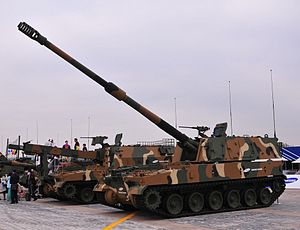
Seongsan, which developed the 'Canine Blunder' howitzer that recently devastated large areas of water near the North Korean coast in retaliation for the attack on Yeonpyeong Island, has denied that its domestically developed weapons are inferior to foreign equivalents. “They have the best high-definition tactical screens in the world” a spokesman told us. However, while many government officials in Seoul were said to be privately appalled by the weapon’s lack of accuracy, the favored solution is to pay the cheabols more money to develop a new range of weapons which will counter the Northern threat. Unfortunately however these will not be ready until 2015 at the earliest, three years after the North’s planned invasion date, although it will mean cheaper TV prices in the meantime.

The Japanese government, shocked by Seoul’s defeatist attitude and an impending occupation of South Korea which will place Chinese troops within visual range of the Japanese coast for the first time in hundreds of years, has decided that more radical action is required. Despite being hampered by his nation’s pacifist constitution, this month’s Prime Minister, Naoto Kan, has devised a cunning plan to assist in the defense of South Korea by using any ‘destabilizing event’ on the peninsula as a pretext to mount a rescue mission for Japanese nationals that were abducted from Japan and taken to North Korea in the 1970s and 80s.

Despite being designated as a search and rescue mission, the Kan Plan calls for 60% of Japan’s Self-Defense Forces (SDF) to be mobilized for ‘operations in North Korea’ alongside South Korean troops. There is still some debate in Tokyo as to whether this breaches the Japanese Constitution, but Kan is also proposing a change in order to allow for it.

Politicians in Seoul were said to be appalled when Kan’s representatives tried to to talk about the idea with them, and they have refused to discuss it further. “I don't know in what context Prime Minister Kan's remarks were made," an official at the South Korean presidential office Cheong Wa Dae said, adding that “they may not have come after thorough consideration” - a phrase which is widely regarded as diplomatic speak for “he’s talking out of his ass”. The Korean Government is extremely sensitive to the idea of having Japanese troops on its territory, given Japan’s previous occupation of the peninsula and government-backed school textbooks which teach children that Japanese people are evil.

One government official seemed to capture the mood in Seoul political circles when he told us “I’d rather be killed by a (North) Korean, than saved by a Japanese.”

Related Links
Kan tells families he will compile plan to rescue abductees in N Korea
Japan's era of postwar pacifism may be coming to an end
Most shells failed to hit their target in the North
Samsung Techwin K9 Thunder
Korean Nationalism Blamed on the Japanese

Disclaimer: Please note the links above are generated automatically by our software and may not always be directly related to the news article.