Friday, November 4, 2011

Koreans' TOEFL Ranking Drops, But Moves Ahead of English Teachers

Figures have revealed that despite a zeal for putting more hours and money into their English language education than their neighbors, Korea's average TOEFL ranking fell from 71st in 2009 to 80th last year when compared against other countries. The TOEFL - or Test of English as a Foreign Language - is the central focus of English teaching in Korea and is used to restrict entry to universities as well as a variety of professions including advertising, construction and the teaching of French.

But in a sign that Korea is making progress in its quest for English proficiency, native-English teachers who took the TOEFL test in 2009 and 2010 as part of a government research program achieved lower scores than their Korean students for the first time. The result has been hailed as proof that Korea no longer needs to tolerate foreigners inconveniencing everyone in Korea, and can instead recruit English teachers domestically by attracting Korean nationals with average TOEFL scores to the profession.

Speaking in English, a spokesperson for the Korean Teacher English Teacher Union said that "Once Korean were student but now we are master become." But a spokesman for AKET - the Association in Korea of English Teachers - fired back at the KTETU statement in a press release "Native english speakers are obviosly better qualifide to teach english and stuff and the korean government should bare in mind that they are only damaging students learning-and-education and not helping students learn proper because spoken and written english best teached by profesional's who use english as a first and only language not confuzed by speaking too things at once."

Some experts have pointed to the fact that Korea's ranking fell while scores remained the same, simply because of improvements in the average scores of other countries which have nothing to do with Korea. As such, the nation's determination to spend more money to maintain its previous year's accomplishment has been justified.

The government has said it will eventually solve the TOEFL ranking problem by introducing a domestic replacement to the test with an assessment and scoring system that will not be directly comparable to the international standard. Because the National English Ability Test (NEAT) will not be recognized by international universities, this will also solve the 'brain drain' issue of Korean students going overseas to study, and then forgetting to come back to Korea afterwards.

Related Links
Koreans’ TOEFL ranking drops
High demand causes 'Toefl crisis' in South Korea
Locally-developed test may replace entrance test of English
State English test gets more support
Trial test for state-run English exam Saturday
Special University Admissions Mean Big Business for Crammers
More talk about the TOEFL in Korea
12-year-old girl gets perfect TOEFL score
TOEFL
Foreigner Meetings Point to Massive Conspiracy

Disclaimer: Please note the links above are generated automatically by our software and may not always be directly related to the news article.

Wednesday, November 2, 2011

Wave of Spousal Disappearances Feared as F6 Visas Introduced

Police are bracing for a wave of spousal disappearances after the government pressed ahead with its plans to introduce a new F-6 visa for foreigners who live in South Korea after marrying South Koreans.

Under a revision to the immigrant foreign criminal control law, the so-called "marriage immigrants" will be given an exclusive F-6 visa, which will allow them to "legally stay in the country even if their marital life ends due to unexpected events such as their Korean spouses' death or disappearance." The law was originally proposed earlier this year, but was held up as legal experts debated the wording of the new law, and whether - given the conditions many foreign immigrants claim they live under - the death or disappearance of a Korean spouse could be termed "unexpected".

The criminal nature of some of these foreigners often causes trouble for the government in effectively handling the steady inflow of these immigrants, according to the Korean Justice Ministry. A ministry spokesman said that the introduction of the new visa would "help the marriage immigrants better adapt themselves to Korean society." Koreans already have the right to have their spouses disappear.

Foreigners lucky enough to be chosen by Koreans for marriage currently receive F-2 residency permits, but they have no right to remain post-divorce, which means that once they have been used up the empty shells are returned to their countries of origin, which has sparked complaints from foreign governments concerned at the increasing strain this has placed on their mental health services. The new F-6 visa will shift some of that burden back to Korea, but the government say that while this will create extra costs, it will also help to promote medical tourism in this country.

The new visa law also allows foreigners to officially buy an F-2 visa for the first time, but it has been met with criticism as the $500,000 cost is much more than the gift to immigration officials used to be, which the new system replaces. However, the ministry has pointed out that an alternate purchase option allows foreign 'investors' a special introductory rate of $300,000 if they hire at least three Koreans - but no foreigners of course - for three years. Given an hourly minimum wage of 4,580 won ($4) this would mean a cost of $10,000 per worker per year, based on a 40-hour work week, giving a total of $390,000 over three years, saving $110,000. In reality, the ministry also accepts that foreigners may adopt the Korean employment practice of requiring employees work 80-hour weeks for half the minimum wage, which will not change the final cost, although foreigners will not be permitted to run prostitution-related businesses. The Vietnamese Embassy has already lodged a protest.

The $500,000 cost of a non-marriage residency visa makes South Korea one of the more expensive OECD nations to buy a place in, but the government is unapologetic, citing its long-standing policy of keeping out foreigners from what are officially classed as 'poor and dirty countries', which has seen only 223 asylum seekers granted entry in the last 20 years. However, the Korean Justice Ministry points out that of the thousands of asylum seekers who have been returned to their regimes, none say they have lived to regret it.

Related Links
New visa to stabilize marriage immigrants' lives in Korea
Divorces by intercultural couples in Korea grow 5%
Minimum Wage Set at W4,580 for Next Year
Korea Must Beware of Growing Crime by Foreigners
Only 223 Given Asylum in Korea in 2 Decades

Disclaimer: Please note the links above are generated automatically by our software and may not always be directly related to the news article.

Tuesday, November 1, 2011

Tokyo Teachers' Union Denies Japan's Claim to Dokdo

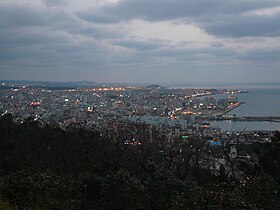
View over Dokdo City
The Tokyo Prefecture Teachers' Union, which represents a massive 20% of public school teachers in the Japanese capital, have finally smashed the wall of Japanese lies and propaganda over the Korean territory of Dokdo, islands in the East Sea which have been Korean for over 5,000 years.

While the Japanese media have pushed ridiculous and historically factually unprovable Japanese claims to the islands, the teachers' union have struck a blow for truth and invalidated Japan's national unity over the issue by clearly stating that Dokdo is not Japanese territory. "If schools teach the government's unilateral opinion that Takeshima is Japanese territory illegally occupied by Korea, it could instill students with emotional nationalism." the union said, referring to Dokdo by its incorrect Japanese name for convenience.

The union have also said that there are no historical grounds for Japan to claim Dokdo, and no historical evidence, stating that "If schools teach the government's unilateral opinion that Takeshima is Japanese territory illegally occupied by Korea, it could instill students with emotional nationalism."

Furthermore, the union says that Japan should apologize to Korea for claiming the territory, and make financial reparations to Korea for the security costs of protecting Dokdo, stating "If schools teach the government's unilateral opinion that Takeshima is Japanese territory illegally occupied by Korea, it could instill students with emotional nationalism."

The union also took the opportunity to renounce Tokyo's claims to the Korean island of Daemado, which is occupied by Japanese military forces and is wrongly called "Tsushima", which means Daemado in Japanese, stating on the subject that "If schools teach the government's unilateral opinion that Takeshima is Japanese territory illegally occupied by Korea, it could instill students with emotional nationalism."

The union says it will campaign against lies in the media, it will no longer tolerate the teaching of mindless propaganda, and it will now correctly inform students that Dokdo is Korean territory, and that Japan is full of lying liars who need to surrender to Korea to avoid conflict, commenting that in future "When we teach this part, we will objectively teach students that Korea and Japan have differing views over Takeshima." adding, "We hope to contribute to efforts to find a peaceful resolution."

Related Links
Tokyo teachers union denies Japan`s claim to Dokdo
Seoul-Tokyo diplomatic spat grows
Korea May Have Existed 'Before Universe Began' - Scientist
East Sea Mistake - It Was Always 'Sea of Korea'

Disclaimer: Please note the links above are generated automatically by our software and may not always be directly related to the news article.